



Wick vs Close: which one counts?
A candle's body and wick, and why only the close breaks a level.
 An ivish.studio lesson
Episode 1 · Series S1: Candle basics · Comment keyword: CLOSE
Takeaway: A wick shows how far price tried to go. The close shows where the candle settled. In this method, a level counts as broken only when a candle closes beyond it.
Hindi: Wick koshish hai, close faisla. Break sirf close se count hota hai.
Watch the reel
The idea in plain words
Every candle has two parts.
- Body: the thick part, from the open to the close.
- Wick: the thin lines above and below the body. A wick marks where price travelled during the candle and then came back from.
A wick is an attempt. It tells you the market reached a price for a moment. The close is the decision. It tells you where price actually finished when the time block ended.
That is why, in this series, a break of a level is counted only on a candle close beyond the level, on the timeframe you are reading. A wick poking through and closing back inside is not a break.
Step by step
Step 1: Read the two parts of one real candle
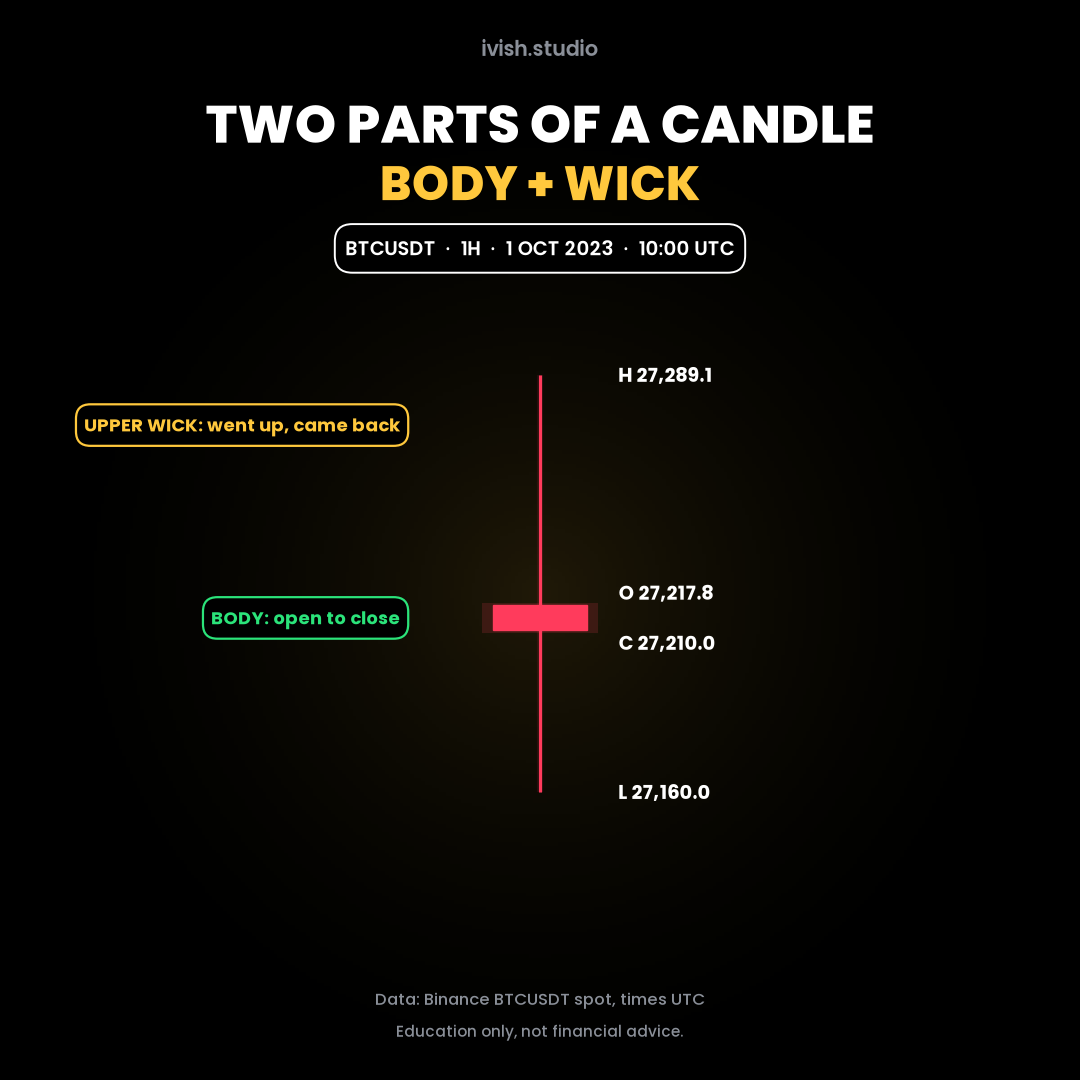
Bitcoin (BTCUSDT spot), 1-hour candle at 10:00 UTC on 1 Oct 2023:
- Open 27,217.78, close 27,210.01. The close is below the open, so the body is small and red.
- High 27,289.08. The upper wick shows price went up there and came back down before the hour ended.
Step 2: Mark a level
The level here is 27,244.89, the high of the 1-hour candle at 07:00 UTC on 29 Sep 2023. From then until this candle, no 1-hour candle had traded above it.
Step 3: Wick above, close below = no break
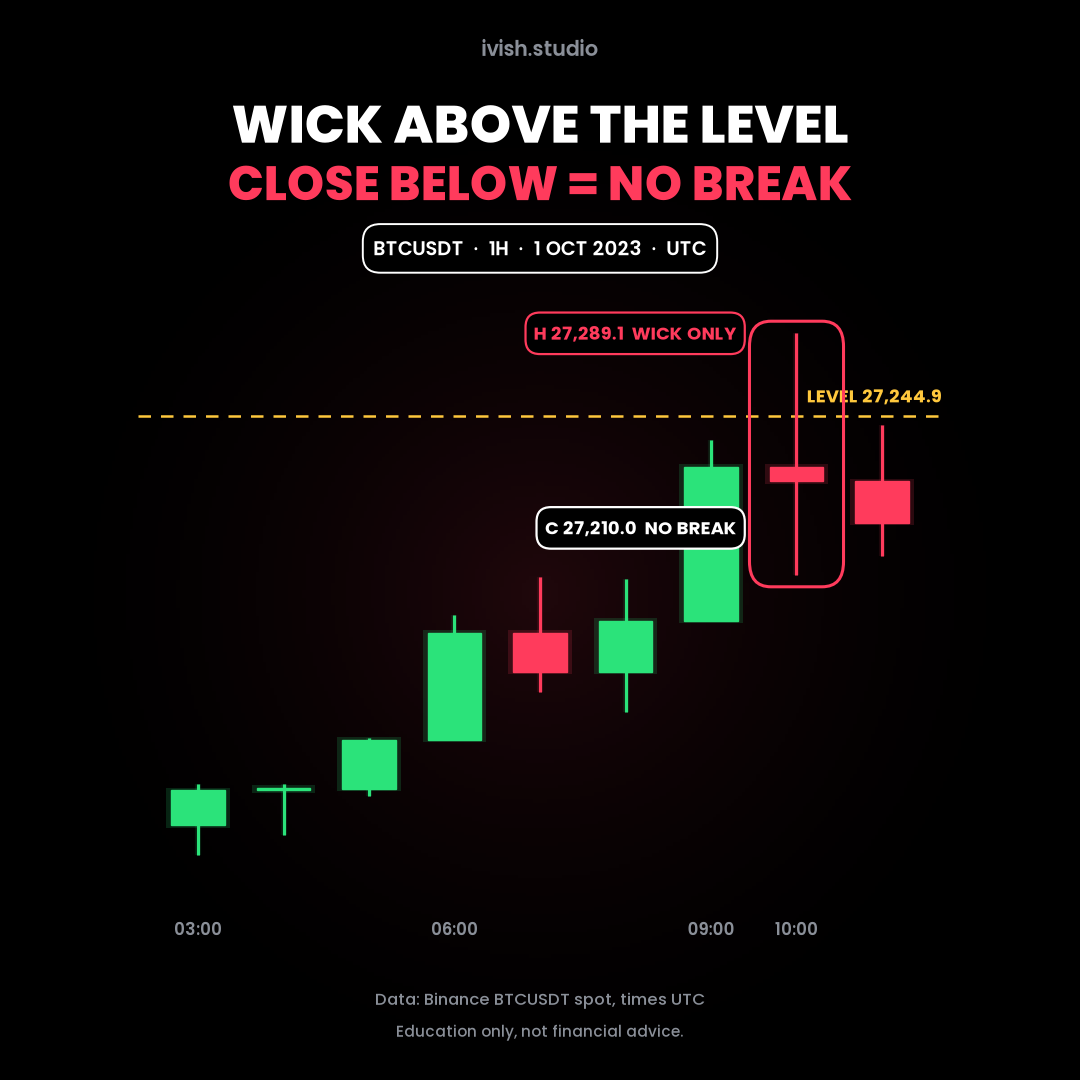
The 10:00 UTC candle went 44.19 above the level (high 27,289.08), but closed 34.88 below it (close 27,210.01). Price tried, and could not stay. In this method that is only a wick, not a break.
Step 4: Close above = the break counts
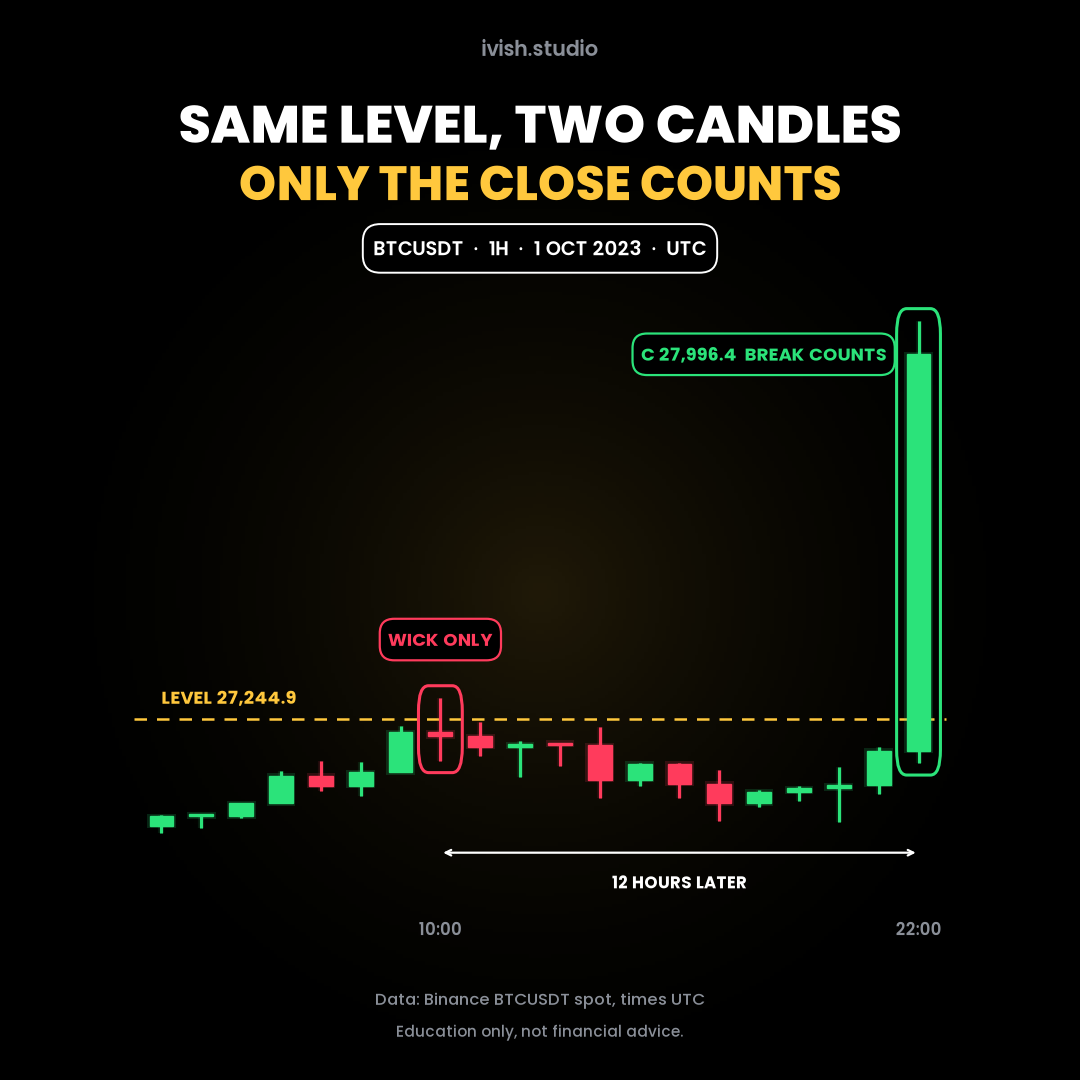
Twelve hours later, the 22:00 UTC candle closed at 27,996.43, which is 751.54 above the level. That is the first 1-hour close above the level, so this is the candle where the break counts.
Same level, two candles, two different answers. The wick was the attempt. The close was the decision.
Common mistakes
- Entering on the wick. Buying the moment price pokes through a level, before the candle closes. The candle can still close back below, as the 10:00 candle did.
- Judging a candle before it closes. Until the time block ends, the “close” is just the current price.
- Mixing timeframes. A close above on a 5-minute chart is not a close above on the 1-hour chart. Always say which timeframe you mean.
- Reading the break as a forecast. A close beyond a level tells you what happened. It does not tell you what price can do next.
Try it yourself
- Open a BTCUSDT 1H chart and draw one clear level (a recent high).
- Find a candle whose wick crossed the level. Where did it close?
- Find the first candle that closed beyond the level. Note the time.
- Count the candles between the wick and the close.
- Say it out loud: “wick = attempt, close = decision.”
Next lesson
Episode 2: One candle, four prices · /trading/learn/002-one-candle-four-prices · comment OHLC
Data: Binance BTCUSDT spot 1-hour candles, times in UTC, re-checked against the Binance public klines API.
Education only, not financial advice.
ivish.studio